
What The Gospels Are
Tools for Dealing with Reality

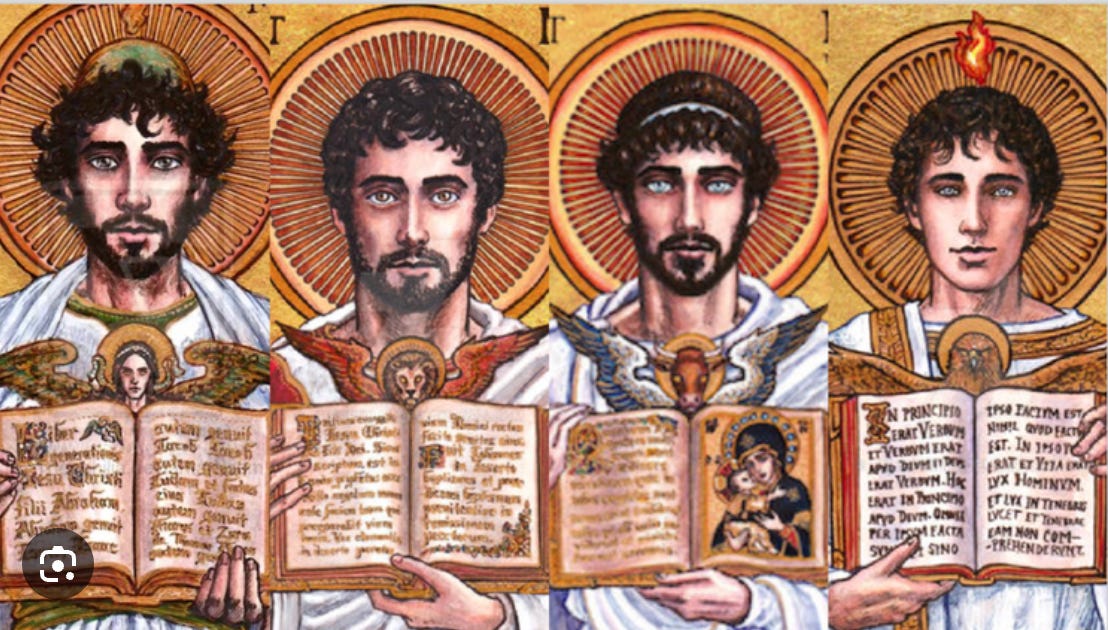
What The Gospels Are
The authors of the Gospels were not in a heated competition to top The Jerusalem Times best seller list. They did not receive royalty checks, or fight for shelf placement in Roman bookstores. Gospel writing occurred before the business of selling books. No Gospel writer ever won a Nobel prize for literature. Gospel writing came from a time when the written word was a product of a community's faith and mission rather than the work of a single author. Gospel writing was an effort in the pursuit of a unifying truth, not a commercial endeavor.
My loose understanding of the Gospels is as follows. The Gospel of Mark arose out of the community that was formed in the spirit of The Apostle Peter. The Gospel of Luke from the community that was formed by the spirit of St. Paul. The Gospel of John was written by the Greek community that circulated around The Apostle . Finally the Gospel of Matthew was born out of Jerusalem.
I am not attempting to be historically accurate. I could be a little off. The point is the Gospels are reflections on and narratives of the good news that animated a particular community. The Gospels were not academically cited and footnoted, although we can see a common source. The Gospel’s at their origin were not peer reviewed, and approved by an institutional process. That would come much later. They are different types of writing. You need to understand what the Gospels “are” before you can hope to understand what they “say”.
I am attempting something similar with The Crowd. I do not charge for this Substack, I do not profit from any publishing or social media. I do not gain any academic standing or tenor by my writing. The writing is designed to get you thinking, to provoke. I call these little segments provocations. I want to get you thinking about one thing for a day or two. If you understand the gospel the way I have come to understand the gospels you will see them as provocations as well. The Gospels are revelations of what is really happening.
We no longer live under the boot of the Roman Empire, but the communities that the Gospel narratives arose out of did live under that boot. When we read the gospel today we lose that context, we miss something. In our modern world we see the Gospels in the context of self help books, or pop psychology. We compare gospel impact to cultural narratives like you find in Hinduism, Confucianism or The Muslim Koran. These writings are not subversive to the culture they arose out of, they are narratives that support the culture. The Gospel is the opposite of these collections. The Gospel subverts. The Gospels are counter narratives that reveal, not state aligned narratives that conceal and justify. (However the temptation to use them that way haunts our history)
The Gospels are accounts of a state sponsored execution, its background, its aftermath and its repercussions. The formal accusation that was hung above Jesus on the cross was INRI. INRI is an abbreviation for the latin phrase “Iesus Nazarenus, Rex ludaerum”, which translates Jesus Christ King of The Jews. It was the inscription placed above Jesus on the cross by order of Pontus Pilate. It was the justifying accusation that led to the punishment of crucifixion administered to Jesus Christ. It is what Pilate put in his official report rather than saying The Crowd had taken control.
The Gospel’s, as they circulated in Roman, Greek and Jewish cultural circles, were counter narratives that refuted this formal accusation. Over time, with input and revision they crystallized into the narratives we have today. These were the unifying narratives that subverted the cultures under whose nose they were hatched. They revealed that the victim was innocent, that Pilate had caved to The Crowd, that The Temple Priest knew what they were doing and that Herod was who they all thought he was.
The formal accusation that hung above the cross was a cover story. If it had been true, if Jesus had claimed to be an earthly King of The Jews his crucifixion would have been warranted, Pilot would have been justified. Pilot however had surrendered his judgment to The Crowd. The Temple priest had surrendered their judgement to Pilot. Herod had not rendered his judgement, like a true politician he hedged his bets. No earthly power had condemned Jesus, rather forces animating The Crowd had conspired. However Pilot, needing a justifying accusation for his report to Rome, hung those famous letters. This troubled the temple priest who did not want Jesus seen as a king. Both sides had the outcome they desired, but the justifying accusation used by Pilate put him at odds with the Temple priest. Herod, like a true politician, had suddenly become friends with Pilate.
The Three Temptations in The Desert
I am putting forth for provocation the idea that the same forces Jesus had faced earlier in The Desert he faced again both as the animating force of The Crowd, and in the institutional power structures of The Roman Empire, The Temple , and The Jewish Culture led by Herod.
Upon beginning his ministry Jesus goes into the desert for 40 days. In the Desert he is faced with three temptations. We have no clear perspective on how these three temptations are manifested. My assumption is that they are a false prompting of the heart, like many of our distractions to prayer. I have seen interpretations where the temptations are presented by an evil figure. I have seen presentations where they are presented as visions. Regardless, Jesus is faced with three temptations.
The temptations are presented to us in a strange way. They are presented as metaphors “turning stones into bread”, “Jumping from the Temple”, “Control of Satan’s Earthly Kingdoms”. Language has its limits. One of our tasks is always to preach the Gospel to the Sign of The Times. Many writers have reduced these to simple terms. Such as “Fame”, “Power” and “Wealth”; or to “Hedonism”, “Egoism” and “Materialism”. I am going to approach these as powers and principalities. I think of these as primal forces that manifest on many levels and function like a Russian Doll.
These temptations can impact us personally, they can disrupt our family, create division in our community and seed unrest in our nation. You need to resist the temptation to simplify these to terms, and instead focus on contemplation and understanding how they are at work in you and in the world around you. These are impactful, primal forces with real power. They combine and manifest in many ways seeking to hide from us the voice of the divine will. They deceive us into focusing on the self instead of sacrifice. The solution will always be a form of discernment needed to separate fact from fiction. There is great wisdom in Rene Girard’s solution of “personal sanctity” as the only thing in our power to hold onto when faced with these forces.
Tools for Dealing with Reality
We are faced on a daily basis with the task of discerning between truth and delusion. The Catholic faith gives us these tools. I have been ruminating on the idea that Rene Girard’s solution to his incredible insight was just “personal sanctity”. I will hope to be writing going forward on the tools of the Catholic Faith and how their true purpose is to help us deal with reality.
I hope to discuss topics such as The Divine Mercy, The Sacred Heart of Jesus (and other MEME’s that save the world), Addiction, Reflect of how to approach the issues in our political discourse all under this idea of Girard’s that the only thing we can do if pursue persona sanctity.
I hope to give my provocations on other Girardian knots such as:
Science is The Child of Christianity
Political Atheism
Apocalypse
My focus since I found myself immersed in the world of Girard after stumbling into it in 2016 is to get this stuff into the Pews. I would love your perspective on how to make sure The Girardian Moment that we are in does not get relegated to a university bookshelf or hidden in Academic journals, but rather find its way into our local parishes.
☮️❤️😉
I became concerned about how The Girardian Moment that we're in may get misused, weaponized by someone who understands it and seeks the path of ambition and power rather than love and forgiveness. Here's a Perplexity prompt I tried,
https://www.perplexity.ai/search/rene-girard-wrote-about-scape-LmK4.R_aRl6Lsm075idBXA
May The Girardian Moment indeed find its way into our local parishes.